





AI Policy Development in Kenya

We offer AI policy development in Kenya for companies, NGOs, schools and SACCOs, so your staff get a clear AI use policy they can follow: which tools are approved, what data must never go into them and who checks AI output before it is used. We write it with your leaders and then train your staff on it.

AI policy development in Kenya: an officer reading policy documents at a desk piled with files

Our corporate partners

“I had an excellent experience learning with EddyLabs. The courses are well-structured, beginner-friendly, and super practical, even if you do not have any technical background.”

Jhene KogiGoogle review

Why your organisation needs an AI policy

A member of your team needs to analyse a customer spreadsheet. An AI tool could help, but the file contains names and contact details. Can they upload it? Which account should they use? What happens to the information after they share it?

Without clear guidance, staff have to make those decisions on their own. The same uncertainty can arise when a team drafts a donor report, prepares a contract or uses AI to answer a customer. A policy gives people a shared starting point: which tools are approved, what information needs protection and who checks the result.

Kenya’s Data Protection Act sets duties for organisations that process personal data. The Office of the Data Protection Commissioner has also called for safeguards when personal data is used with AI. Your policy should fit those duties and the work your people do.

The goal is to make safe use easier, not to stop useful work. Staff should be able to find an answer before they share information, and know who to ask when a case is unclear.

What your AI policy covers

AI use policy for staff: employees working at computers in an open-plan office

Approved tools and how to use them

We list the AI tools your staff may use, the accounts they must use them on and the settings to switch on, such as turning off chat history for training where a tool allows it.

The list is short and practical, so staff do not need to guess which new app is allowed.
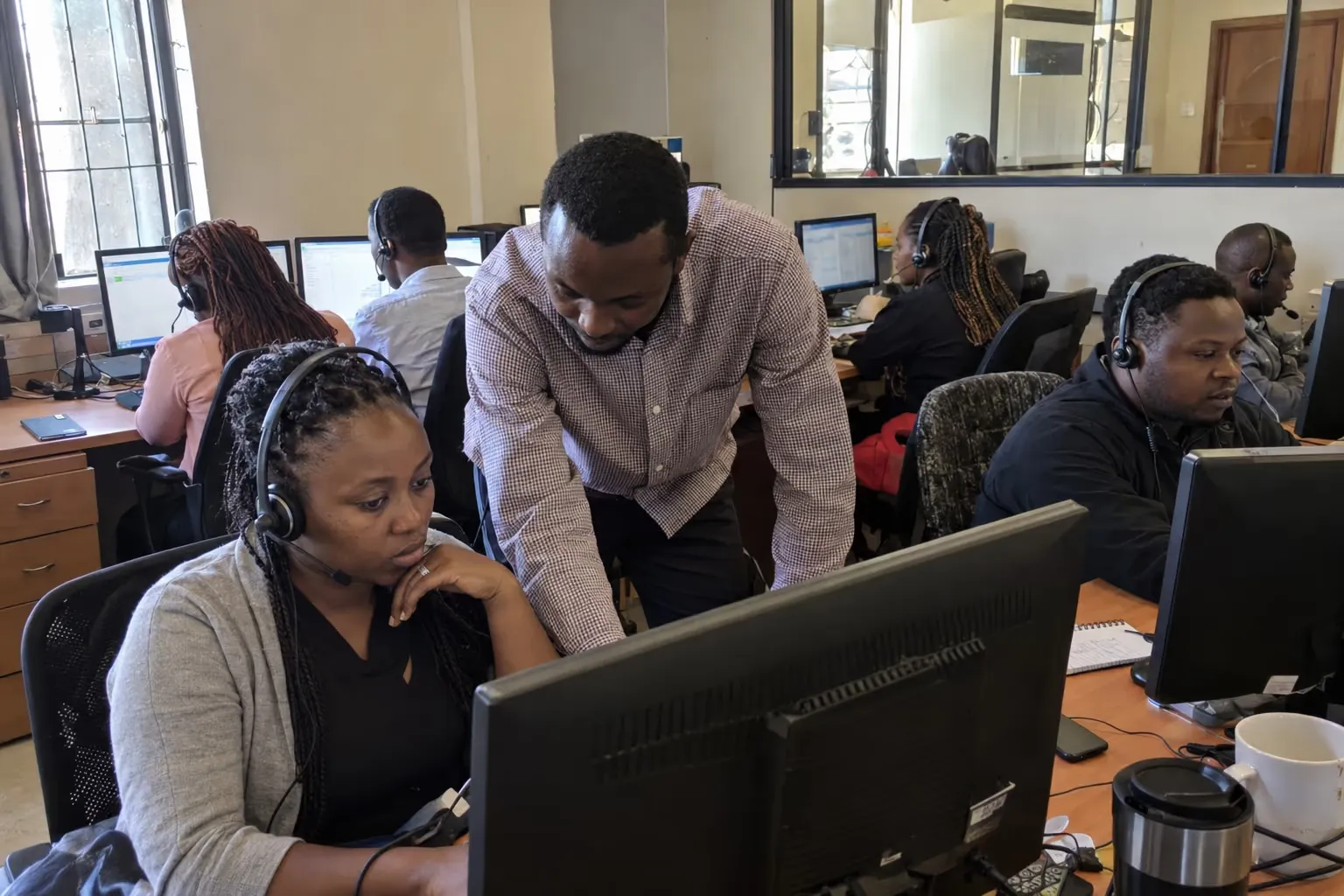
AI data protection policy: customer care agents with headsets at their computers while a supervisor helps

Data protection rules

We set clear rules on which information can never go into an AI tool, such as personal data, health details, client files and confidential plans, and how to remove identifying details when AI help is needed.

The rules follow the Kenya Data Protection Act, 2019, and any rules from your regulator, funders or clients.

AI governance policy workshop: a facilitator explaining a point beside a whiteboard to a seated group

Checking AI output and accountability

AI can invent facts, figures and sources. The policy says who must check AI output, what they check and when you tell a client, donor or regulator that AI was used.

It also makes clear that a person, not a tool, stays responsible for every decision and document.

Staff training on an AI policy: a participant raising her hand to ask a question during a session

Training staff to follow it

A policy that nobody reads does not protect you. We run a short session for staff that explains each rule with examples from their own work.

We also give you a one-page summary to share, and a simple process to review the policy as tools and laws change.

Tell us about your organisation and how your staff use AI today.

Plan your AI policy
A practical example

What can your team put into an AI tool?

Staff need more than a warning to be careful. A simple guide can help them decide when to stop, when to ask and when a task may be suitable for an approved tool.

Example data guide for staff using AI
CategoryExampleStarting point
RedM-Pesa statements, KRA PINs, SACCO member loan files, beneficiary lists, employee health details or unredacted contractsDo not enter the information into an unapproved AI tool. Ask the person responsible for data protection.
AmberDe-identified survey results, donor report drafts with personal and location identifiers removed, or internal SOP draftsCheck the tool, the information and your organisation’s rules before use. Removing names alone may not make data anonymous.
GreenPublicly published reports, general correspondence templates, public FAQs for Kiswahili or English translation, or fictional training examplesUse an approved tool and check its output before relying on or sharing it.

This is an illustration, not a legal classification. Your rules depend on the information, the tool, your organisation’s approvals and the duties that apply to you.

Discuss a policy for your team

Why AI policies can be hard to follow

A policy is useful when staff can apply it to the decisions they face at work.

Staff cannot find a clear answer

A long document can leave people unsure about an ordinary task. We organise the rules around practical questions and prepare a short summary staff can refer to.

The rules do not match the work

A generic template may miss the tools, documents and decisions your teams use. We discuss those workflows with you before drafting the policy.

The policy is shared without explanation

People need to know how the rules apply to their role and who can answer questions. We include a staff session with examples drawn from your organisation’s work.

How AI policies differ by sector

The risks and rules depend on the people and information your team works with.

Banks, SACCOs and fintechs

Consider financial data confidentiality, audit trails and the applicable CBK or SASRA requirements.

NGOs and development agencies

Protect beneficiary information and account for donor requirements when staff use AI for monitoring, evaluation and reporting.

Schools, colleges and universities

Set rules for administrative and teaching work, student assessment and academic integrity.

Corporate and SME teams

Protect client proposals, pricing information and internal intellectual property across sales, HR and operations.

How we develop your AI policy

  1. Review

    Find the risks

    We talk to your leaders and staff to learn how AI is used today, which data you hold and which rules already apply to you.

    You receiveA short risk summaryWhere AI is used and where the risks are.

  2. Draft

    Write it plainly

    We write a policy in plain English that fits your size and sector, with rules staff can follow without a lawyer.

    You receiveA draft AI use policyA 3 to 5 page core policy in Word or PDF, plus a one-page staff quick reference covering approved tools, data rules, human checks and incident reporting.

  3. Agree

    Get sign-off

    We review the draft with your management, and board where needed, and make the changes they ask for.

    You receiveAn approved policyReady to share with every member of staff.

  4. Train

    Make it real

    We train your staff on the policy with examples from their own work and answer their questions.

    You receiveStaff who follow itA staff session and a date to review the policy.

We agree on the scope and fee before work begins. These depend on your organisation, the people involved and the training you need.

Who writes your AI policy

Your policy is led by Edwin Rogoi, an AI trainer and consultant in Kenya and the founder of EddyLabs. Edwin has trained teams across companies, schools and NGOs, so the policy is built on how staff actually use AI, not on a template from another country.

In 2026, Nairobi Startup Garage named Edwin Assistive Technology Enabler of the Year, and EddyLabs is rated 4.9 on Google from 14 reviews. We work with organisations anywhere in Kenya, in person or online. Read more about Edwin.

Questions about AI policy development

What is an AI use policy?
It is a short document that tells staff which AI tools they may use, what information must never go into them, who checks AI output and who is responsible for the result.
Is there an AI law in Kenya that we must follow?
Kenya’s Data Protection Act, 2019 applies when an organisation processes personal data, including through AI tools. Other duties may depend on your sector and how you use the tool. Our guide to AI strategy for businesses in Kenya explains the wider policy context.
How long should an AI policy be?
Short enough that staff read it. For most organisations, two to four pages plus a one-page summary is enough.
Can you write a policy for a school or an NGO?
Yes. We adapt the policy to your sector, for example rules on student assignments for a school, or funder and beneficiary data rules for an NGO.
Do you train staff on the policy?
Yes. A short staff session is part of the service, and we can add fuller corporate AI training if your teams need it.
How do we get started?
Book a free 30-minute call. We agree the scope and fee before any work begins.

Ready to give your staff clear AI rules?

Book a free 30-minute call. We will look at how your team uses AI today and plan your policy.

Book a free call